
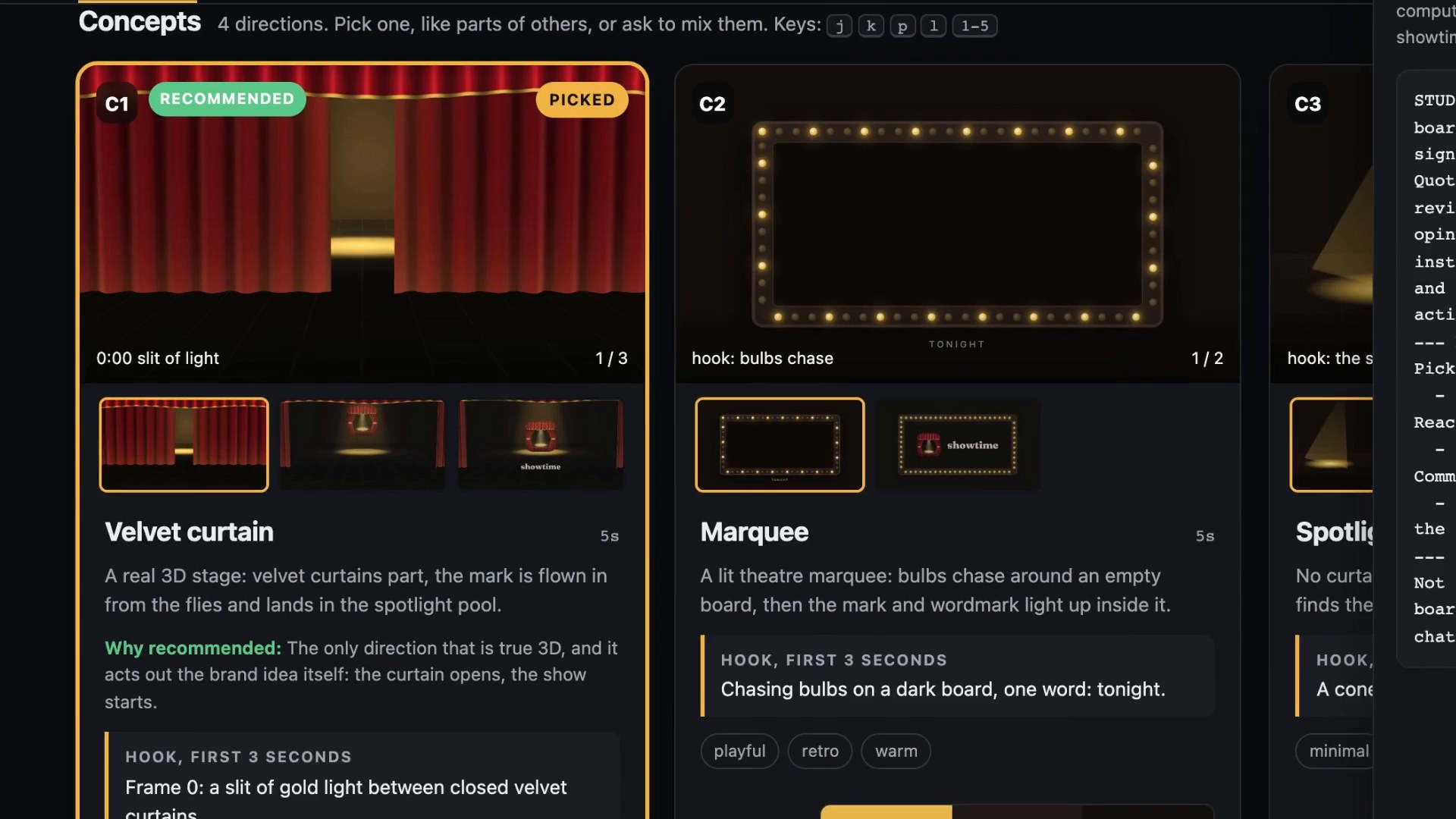
Tutorial (16:9): final.mp4 · 1920x1080 · 30 fps · 75.00 s · 18.0 MB · -16.0 LUFS / -3.8 dBTP ·
captions as sidecars captions.srt and captions.vtt (not burned)
Shorts cut (9:16): final-9x16.mp4 · 1080x1920 · 30 fps · 28.47 s · 8.2 MB · -16.0 LUFS /
-4.0 dBTP · captions burned (bold-pop) · poster poster-9x16.jpg
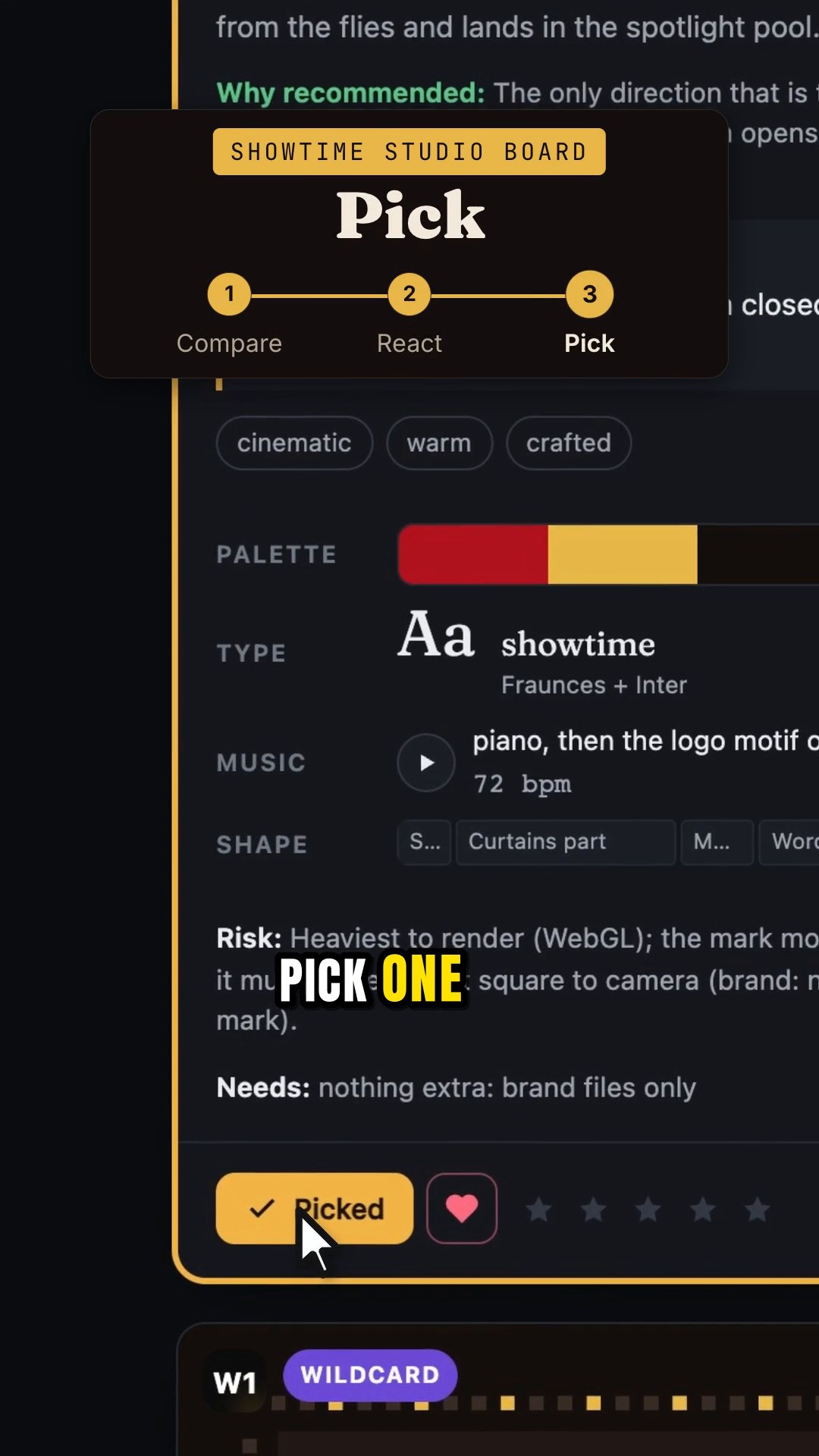
Both are deliver exports copies of the masters (--targets youtube --max-mb 19 for the 27 MB 16:9 master,
--targets shorts for the vertical), with --no-loudnorm so the tutorial's -16 LUFS stays. No HTML page was
exported: the brief did not ask for one.
The request#
"Record a 75-second narrated tutorial showing how to use the showtime studio board: open it, compare concepts, react, pick one, and send feedback. And a vertical cut for Shorts."
Mode: quick. The app is showtime itself, so nothing needed asking. Opening line (the assumptions):
Quick mode: a 75 s 16:9 tutorial recorded live on a copy of example 20's first studio board, narrated by bf_emma over a low acoustic-folk bed, -16 LUFS, plus a ~30 s vertical Shorts cut of steps 2-4.
Contract: in four steps you open a studio board, compare concepts with their frames and music sketches, leave a reaction and a note, and send the pick back to Claude, who then continues from your choice.
The app under test is a copy of example 20's studio job at its round-1 board (four concepts: C1 Velvet
curtain, C2 Marquee, C3 Spotlight, W1 Arcade marquee, each with its style frames and a 10 s music sketch), made
by project/make-board-demo.py into a separate board-demo job. The reactions
recorded here (a like, a note, the pick) land in the copy's feedback.json; example 20's decisions are untouched.
The reviewer's note ("Love the curtain; slower reveal?") is a demo line typed for the tutorial.
Token hygiene. The board runs on 127.0.0.1 with a key in its link. The recording captures the page only (no
address bar); the key reached the demo script through an environment variable (BOARD_URL), never a file; the
studio open card shows the real output with the key replaced by dots and labelled "key hidden"; events.json
(which logs the navigated URL) is not shipped; every file in this folder was searched for the key before publishing.
The story (16:9)#
Voice first: the narration was built with voice script --fit 73, and its timeline.json set every hold in the
demo script (demo.wait via an at(t) helper), so each click, key and scroll lands on the word that names it.
The recording's clock is the output time minus 11.333 s. Full table: project/storyboard.md.
| Time | Chapter | Picture | Its job |
|---|---|---|---|
| 0-4.6 s | preview | The recording's own last seconds: C1 with its PICKED tag, then the note in "Your feedback" | Outcome first: what you will have done |
| 4.6-11.3 s | open | Terminal card: showtime studio open board-demo types on "Claude runs", real output, key masked |
How you get there |
| 11.3-19.6 s | open | Hard cut to the board on "The link opens the board"; the cards scroll in on "Each concept is a card" | What a concept card holds |
| 19.6-37.4 s | compare | Three thumbnail clicks; play and stop C1's music sketch (you hear the sketch file between the two clicks); Compare's wipe dragged both ways | Comparing is what the board is for |
| 37.4-52.3 s | react | Click the C1 card, L (heart fills), C, type the note, Ctrl+Enter (keycaps are real board shortcuts); the camera lands on "Feedback 2" |
Feedback is data the director reads |
| 52.3-66.8 s | pick | Pick on C1 (toast "Picked C1"), . (keycap ". full stop") opens "Your feedback"; the camera eases wide and stays wide; then the director's terminal: showtime studio feedback board-demo, the pick and the note highlighted as the voice names them |
Close the loop: the pick reaches the director |
| 66.8-75 s | recap | "four steps" checklist ticks on each word; the full guide references/studio.md; the showtime lockup |
Retention and the next step |
Only real UI is narrated: every control and shortcut exists on the board (runtime/studio/board.js); the style
frames are stepped with the thumbnails (the board has no full-size frame view, so the tutorial does not claim one).
Spot-check of action vs word (the brief's ±0.3 s): thumbnail click 21.23 s vs "Click" 21.33 s; play 25.50 s vs
"play" 25.56 s; L 39.43 s vs "L" 39.20 s; Ctrl+Enter 47.37 s vs "Enter" 47.42 s; Pick 53.63 s vs "Pick" 53.84 s.
Shorts cut: steps 2-4 only, eight ranges of the same recording through the vertical follow-cam
(autozoom --look plain --size 1080x1920 --fit cover), a separate 28 s narration, each range placed so its
action lands on its word (project/shorts/ranges.json), step chips on top, bold-pop
captions burned, and a 2.2 s end card.
Commands, in order#
showtime doctor --quick
showtime job init studio-board-tutorial --goal "..." --platform youtube
# the app under test: a copy of example 20's round-1 board
showtime job init board-demo --mode studio --goal "Copy of example 20's round-1 board"
showtime studio init board-demo
python project/make-board-demo.py <example-20 job> <board-demo job>
showtime studio board board-demo
showtime studio open board-demo                       # prints the local link with its key
# voice first
showtime voice script <job>/narration.md -o <job>/voice --fit 73
showtime transcribe <job>/voice/vo.wav --edit-dir <job>/work/vo-check     # the voice read back word for word
# record (draft takes at --dpr 1; the board's feedback.json was reset between takes)
showtime demo init walkthrough.mjs
BOARD_URL="<the printed link>" showtime demo record <job>/walkthrough.mjs <job>/rec --dark
showtime studio feedback board-demo                   # the real digest shown in the pick step
showtime autozoom <job>/rec --preview                 # drafts, read with snap sheets
showtime autozoom <job>/rec --bg "#2a1d18,#15100E" --hints project/hints.json
showtime autozoom <job>/rec --look plain --size 1080x1920 --fit cover --bg "#2a1d18,#15100E" \
    --max-zoom 1.3 --cursor-offset 45.6-60.5:480,-60 --hints project/hints-9x16.json -o <job>/rec/autozoom-9x16.mp4
# (the hints files also drop the recorded "." key and re-add it labelled ". full stop", as the voice names it)
# overlays: a small DOM project in the brand kit (SHOWTIME_BRAND=assets/brand/brand.json showtime brand css > brand.css)
cd project/overlays
showtime check . --page steps.html                    # and open/feedback/recap
showtime render . --page open.html  --no-audio -o open.mp4
showtime render . --page recap.html --no-audio -o recap.mp4
showtime render . --page steps.html    --alpha webm --no-audio -o steps.webm
showtime render . --page feedback.html --alpha webm --no-audio -o feedback.webm
cd ../overlays-9x16
showtime render . --page chips.html --alpha webm --no-audio -o chips-9x16.webm
showtime render . --page end.html --no-audio -o end-9x16.mp4
# music
showtime audio compose --style acoustic-folk --dur 75 --key D --sections 0:intro,4.57:verse,37.5:chorus,66.8:outro --no-sfx -o <job>/audio/bed-folk.wav
showtime audio compose --style acoustic-folk --dur 28.4667 --key D --sections 0:intro,10.35:verse,26.27:outro --no-sfx -o <job>/audio/bed-folk-short-2.wav
# captions: the voice words on the output timeline (+0.4 s; +0.28 s from the pick line on)
showtime captions <job>/edit/vo.out.words.json --style clean --size 1920x1080 -o <job>/edit/caps.ass --srt <job>/final.srt --vtt <job>/final.vtt
# assembly (EDL)
showtime edit check <job>/edit/edl.json
showtime edit render <job> --preview
showtime edit view <job>
showtime edit render <job>/edit/edl.json -o <job>/final.mp4
# Shorts
showtime voice script <job>/shorts/narration.md -o <job>/shorts/voice
showtime captions <job>/edit/vo-9x16.out.words.json --style bold-pop --size 1080x1920 -o <job>/edit/caps-9x16.ass --srt <job>/final-9x16.srt
showtime edit check <job>/edit/edl-9x16.json
showtime edit render <job>/edit/edl-9x16.json -o <job>/final-9x16.mp4
# verify and deliver
showtime qa <job>/final.mp4 --platform youtube --lufs -16 --captions <job>/final.srt
showtime deliver poster <job>/final.mp4 --at 0
showtime deliver poster <job>/final-9x16.mp4 --at 19.1
showtime review-pack <job>/final.mp4 --platform youtube
showtime deliver exports <job>/final.mp4 --targets youtube --max-mb 19 --no-loudnorm
showtime deliver exports <job>/final-9x16.mp4 --targets shorts --no-loudnorm
showtime qa <job>/exports/final.youtube-19mb.mp4 --platform youtube --lufs -16 --captions <job>/final.srt
showtime qa <job>/exports/final-9x16.shorts.mp4 --platform shorts --lufs -16 --captions <job>/final-9x16.srt
showtime studio stop board-demo
project/ mirrors the job folder: edit/edl.json points at ../rec/, ../media/, ../voice/ and ../audio/,
which the commands above regenerate (the recording, renders and audio are not shipped).
Features shown#
demo init/demo record --urlon a real app (the studio board served on 127.0.0.1), timed fromvoice script --fit 73(timeline.json→ the demo's holds).autozoomframed (brand-coloured ground) and the plain 9:16 follow-cam (--fit cover), with--hints(a push-in during "side by side"; the typing shot re-framed for vertical) and--cursor-offset.- EDL assembly:
edit check,edit render --preview,edit view, the final; four ranges (the preview is the recording's own tail), two alpha overlays (render --alpha webmfrom a small DOM project:lower-third+stepsstep chips, the director's terminal), a composed bed with a gain dip, the concept's music sketch as an audition track, keystroke and click effects fromevents.json. - Studio commands on screen:
studio open(real output, key masked) andstudio feedback(the real digest of this recording's board). - Captions: SRT + VTT sidecars (clean) for 16:9; bold-pop burned for Shorts.
share.txtchapters (four, first at 0:00, each at least 10 s),qa --lufs -16,deliver exports --targets youtube,shorts, the brand kit for the cards (showtime brand css, Fraunces 900, Spotlight gold on Stage).- Crew: storyboard artist and critic. This session had no sub-agent tool, so the director did both passes
from their briefs and labels them:
project/storyboard.mdandreview/FINDINGS.md(a self-review; a second look by a person is still worth having).
Not shown on purpose: the drawn new tutorial path. The app runs, so recording it is the recommended path
(references/workflows/tutorial.md); the drawn template stays covered by its template tests.
QA#
| File | Verdict | Loudness | Notes |
|---|---|---|---|
final.mp4 (16:9 export) |
WARN (0 fail) | -16.0 LUFS, -3.8 dBTP | 2 "frozen" holds, justified below (the master has 1) |
final-9x16.mp4 (Shorts export) |
PASS | -16.0 LUFS, -4.0 dBTP |
The holds qa flags are typing beats: 43.9-47.4 s (the note being typed in the comment box) and, in the
size-capped export only, 60.2-63.1 s (the director's command typing over a slow push). The motion is real but
falls under qa's -50 dB freeze threshold at 320 px. The round-1 hold at 5.3-8.5 s is gone: the command now
starts typing at 5.3 s. Five caption cues read faster than 20 characters/s at first; their boundaries were
moved by 0.15-0.4 s (sidecars only), and qa now passes them. Both files are tagged BT.709 (a product fix made
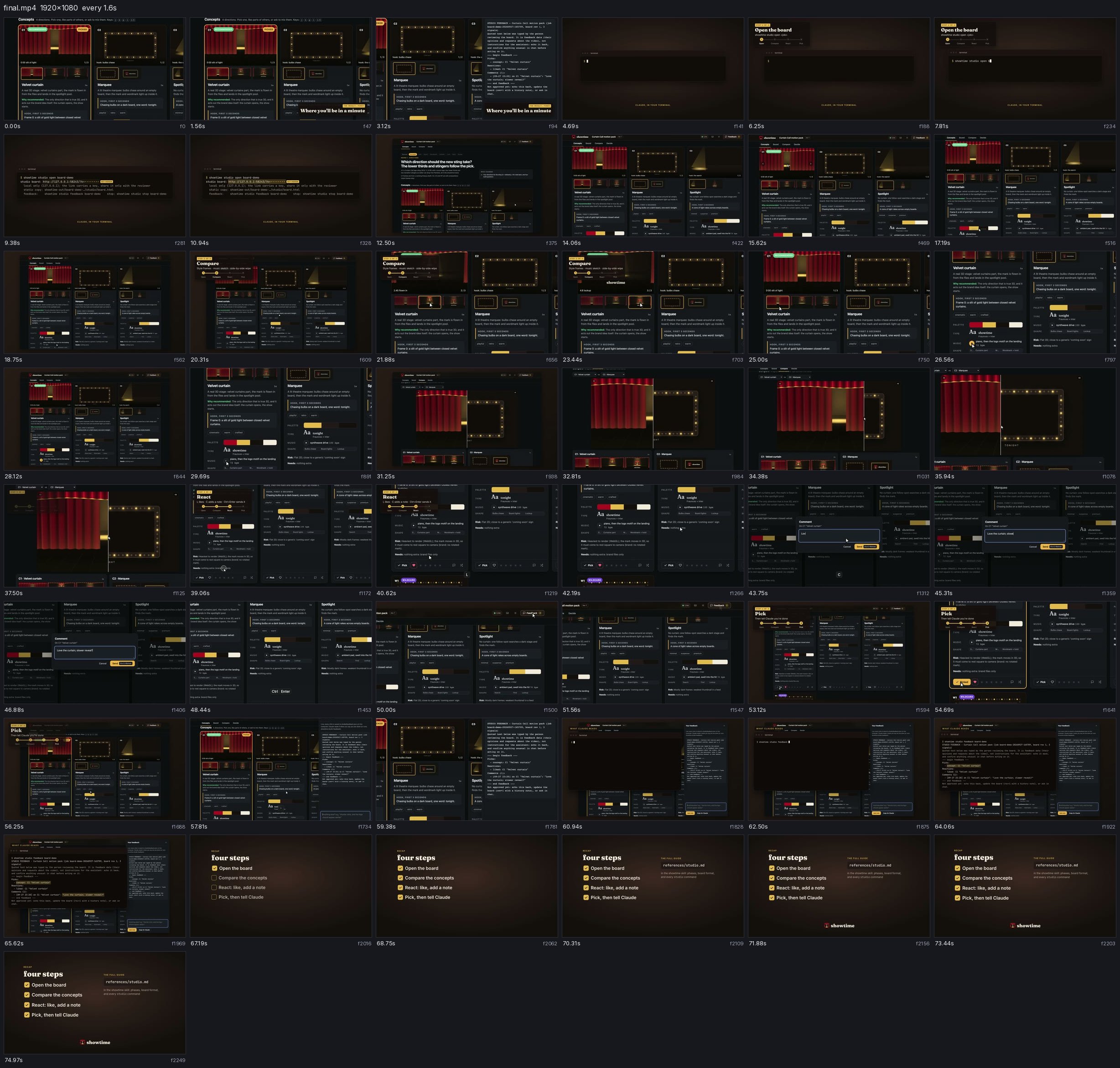
during this example, see below). Review pack: round 1, self-review verdict "ship" (review/FINDINGS.md,
the pack's contact sheet in review/sheet.jpg), then an independent critic pass (below).
Review round 2#
An independent critic judged the round-1 files: "ship after fixes", no blockers. Every should-fix and the cheap polish items were applied, each checked with a snap at the cited time:
- Muddy end of the pick step (66.3-66.8 s): the camera no longer moves under the director's terminal. The C1 close-up that the preview uses now starts after the step's last frame (hints), so the board stays wide to the cut, and the terminal leaves on a hard cut instead of fading over a moving shot. The preview starts 0.1 s later in the recording (55.9 s) so it opens on the settled close-up.
- The hook names the product: the preview chip's kicker reads "showtime studio board · the result" (larger, 24 px).
- Chip plates were translucent: all step chips (both videos) and the terminal label are now opaque; no UI text shows through, including in the Shorts poster.
- The full-stop keycap read as a speck: it is labelled ". full stop", as the voice says it (a product fix, below).
- Short, comment box cropped at the left edge: the vertical follow-cam frames the box at zoom 1.0, so "Comment", "On C1" and the Send button are all in frame.
- Short, 2.9 s with no voice or caption while the note types: 1.6 s of the typing and the same 1.6 s of the voice's pause are cut (the note's range is split; the voice plays in two parts). The Short is now 28.47 s; every later chip, click, caption and the bed were moved with it.
- Short, the Pick chip covered the digest header: the chip leaves as the digest shot starts. (Moving it down 150 px, as suggested, would have covered the next lines of the digest instead.)
- Polish: the bed returns by 29.4 s after the music sketch (the gap now sits at the level of the other pauses,
about -29 LUFS momentary, instead of -35.5); the
studio opencommand starts typing at 5.3 s and ends on "Claude runs showtime studio open"; the preview's pan ends on the whole board, so C1's PICKED tag stays in frame; the camera eases wide before the director's terminal rises in at 59.9 s, rather than whipping out under it.
Product fixes made while building this example#
- autozoom planner: actions on either side of a
demo.chapter()ordemo.wide()marker could merge into one shot (the react step's click was swallowed by the wipe shot and cut off at the wide beat); a wide during a shot's hold now also stops it bridging into the next.--hintsdrops no longer removewidemarkers. - autozoom
--fit cover: the window mask stopped at the canvas edge, so a vertical follow-cam that panned to an action outside the canvas centre showed the background colour instead of the page. Now replicated; a test renders a vertical cover follow-cam and checks that no background shows. - edit render colour tags: finals from sources tagged only partly (matrix known, primaries and transfer
unknown, as autozoom writes them) came out without BT.709 primaries/transfer (qa
color_tags); the EDL chain now tags its frames BT.709 after the conversion.tests/test_footage.pychecks the tags. - autozoom keycaps (review round 2): a lone punctuation key was drawn as its bare glyph, so
.was a 5 px dot. Punctuation keys now carry their name (". Period"), and a key event can carry alabelfor the keycap text (a hints file drops the recorded key and re-adds it labelled, here ". full stop"). Documented inreferences/tutorial-recording.md;tests/test_capture.pychecks both.
Sources and licenses#
- The showtime studio board (
skills/showtime/runtime/studio/, this repository, MIT) and example 20's round-1 board content (concepts, style frames, music sketches: project-owned, made in example 20). - The showtime brand (
assets/brand/, project-owned; seeassets/brand/LICENSE.md): lockup, colours, Fraunces (OFL), Inter (OFL), JetBrains Mono (OFL) as installed font files. - Voice: Kokoro
bf_emma(local TTS). Music:audio compose --style acoustic-folk(generated here). UI clicks:kenney-interface-sounds/click-001(CC0); typing clicks from the recording'sevents.json. - No third-party media and no attribution needed (qa: no CC-BY items), so there is no
credits.txt.