● nobel-2026-lab

October 2026 · a lab for learning

This year's Nobel Prizes, hands on

Each prize gets a fact sheet where every sentence has a source, a small model you can run on a laptop, and a short video; most stop and ask you to guess before they tell you.

Educational demos made to show an open-source tool. Not research, and not for any lab or clinical use. The models are teaching toys.

Every video here is made with showtime, an open-source video studio for coding agents →

Medicine: the light switch

Physiology or Medicine 2026

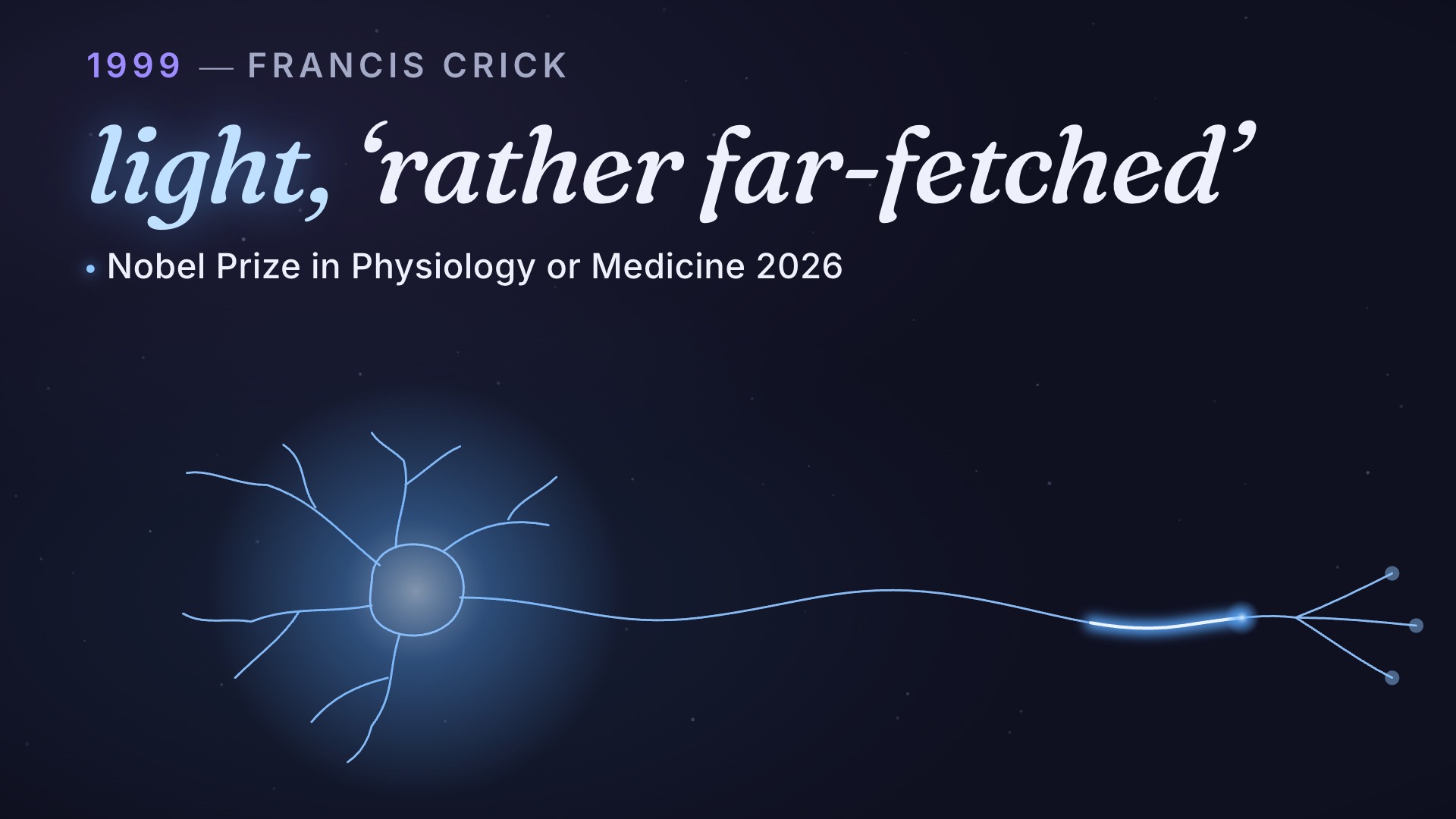
A neuron drawn in thin blue lines with a pulse of light along it, under the words: 1999, Francis Crick, light, 'rather far-fetched'. Nobel Prize in Physiology or Medicine 2026. Play · 2:21 · stops at 3 questions

The story in one line

In 1999 Francis Crick wrote that light would be the ideal signal for switching neurons, then called the idea “rather far-fetched”.

On 5 October 2026 the prize went to Karl Deisseroth, Peter Hegemann and Georg Nagel “for their discoveries concerning light-gated ion channels and optogenetics” (press release).

Physics: a telescope made of ice

Physics 2026

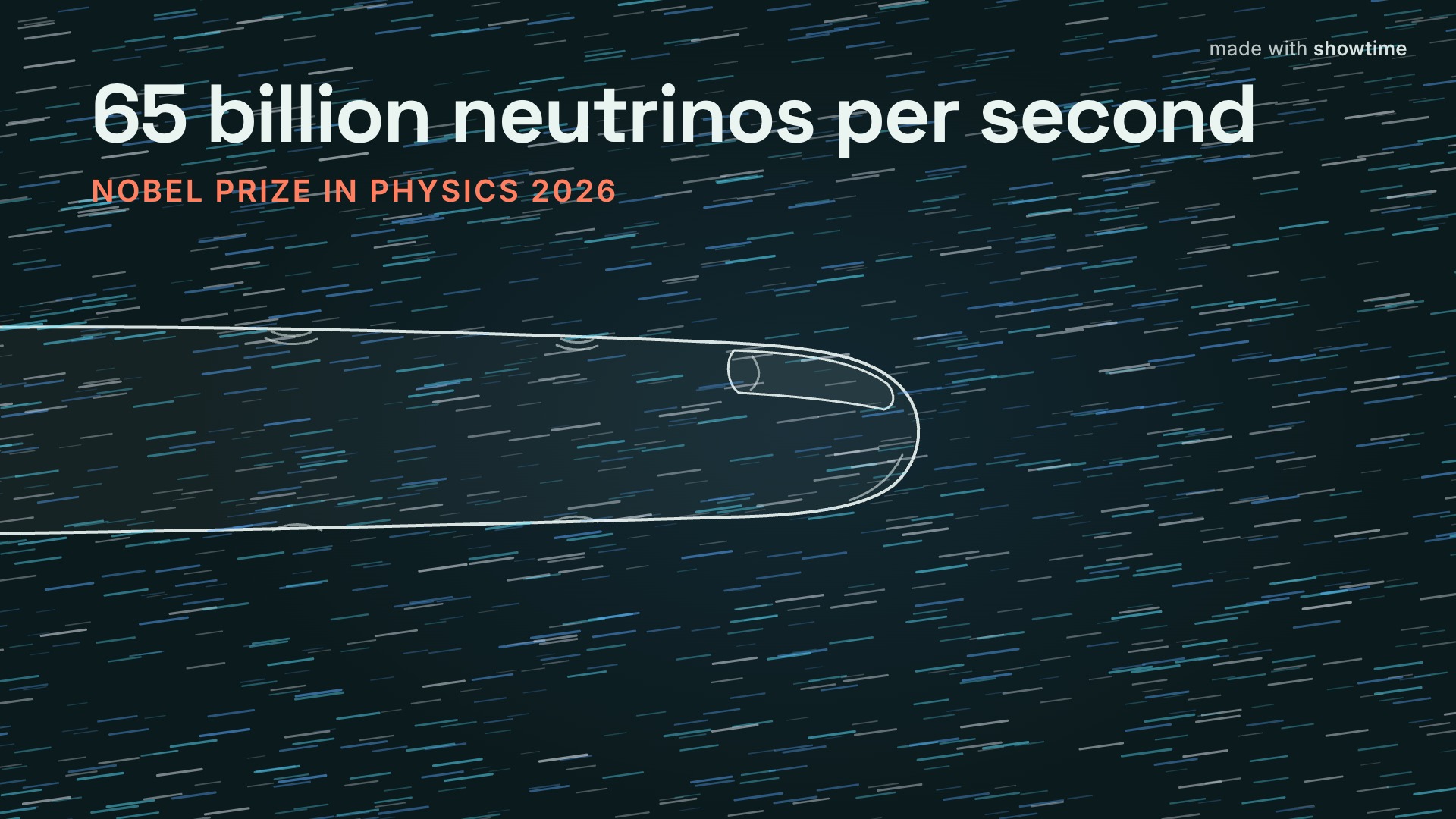
A line drawing of a fingertip with a stream of neutrinos passing through it, under the words: 65 billion per second. Nobel Prize in Physics 2026. Play · 2:37 · stops at 3 questions

The story in one line

About 65 billion neutrinos from the Sun pass through your little fingernail every second, and almost none of them touch anything. So how do you catch one?

On 6 October 2026 the prize went to Francis Halzen “for decisive contributions to the IceCube Neutrino Observatory and the discovery of high-energy neutrinos of astrophysical origin” (press release).

Chemistry: one hand wins

Chemistry 2026

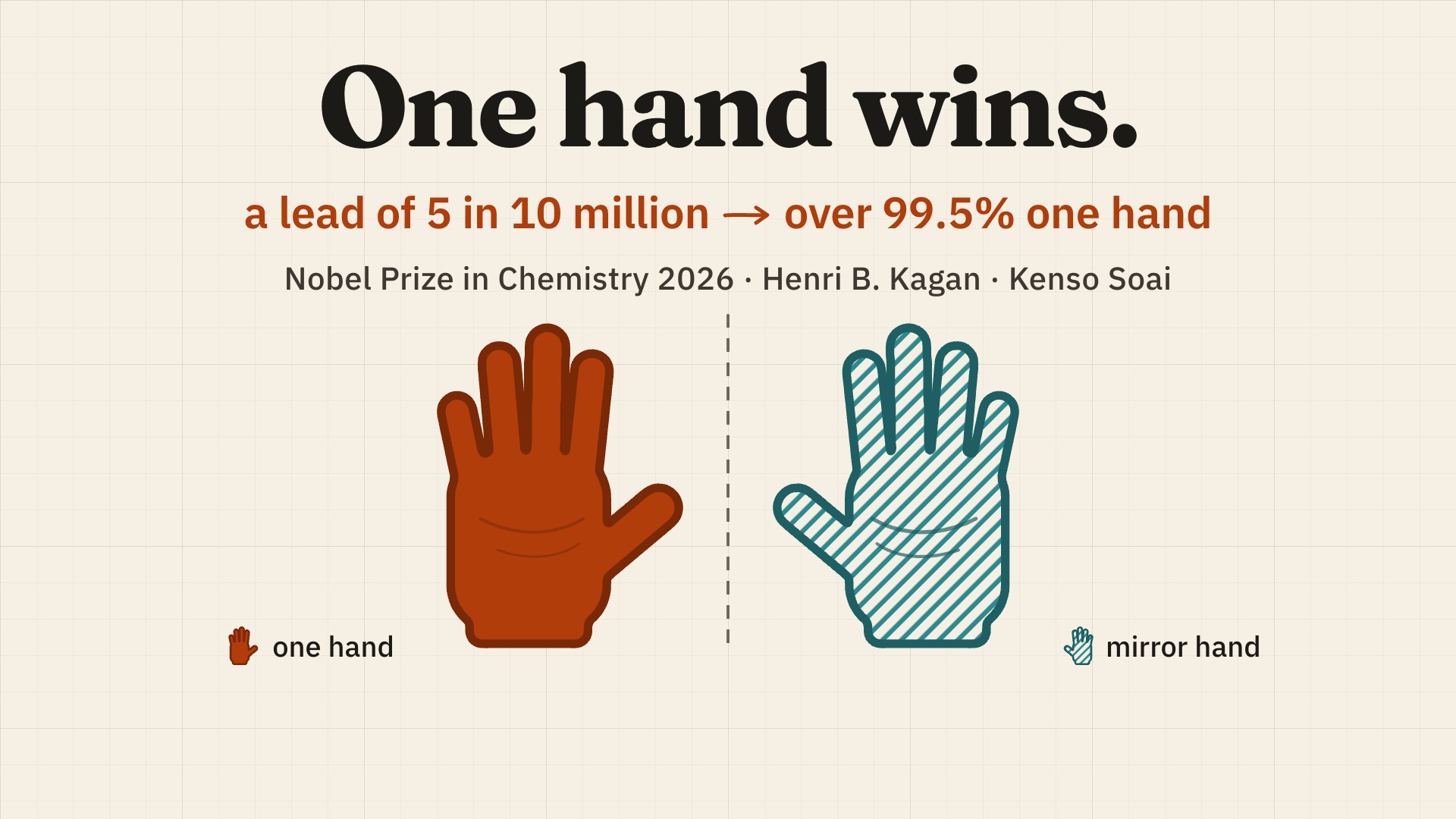
Two drawn hands on either side of a dashed mirror line, a solid orange one hand and a hatched teal mirror hand, under the words: One hand wins. A lead of 5 in 10 million, then over 99.5% one hand. Nobel Prize in Chemistry 2026, Henri B. Kagan, Kenso Soai. Play · 2:30

The story in one line

Many molecules come in two mirror forms, like your hands, and life uses only one. How can a reaction choose a hand?

On 7 October 2026 the prize went to Henri B. Kagan and Kenso Soai “for the discovery of non-linear effects and autocatalysis in asymmetric organic synthesis” (press release).

Literature: what survives

Literature 2026

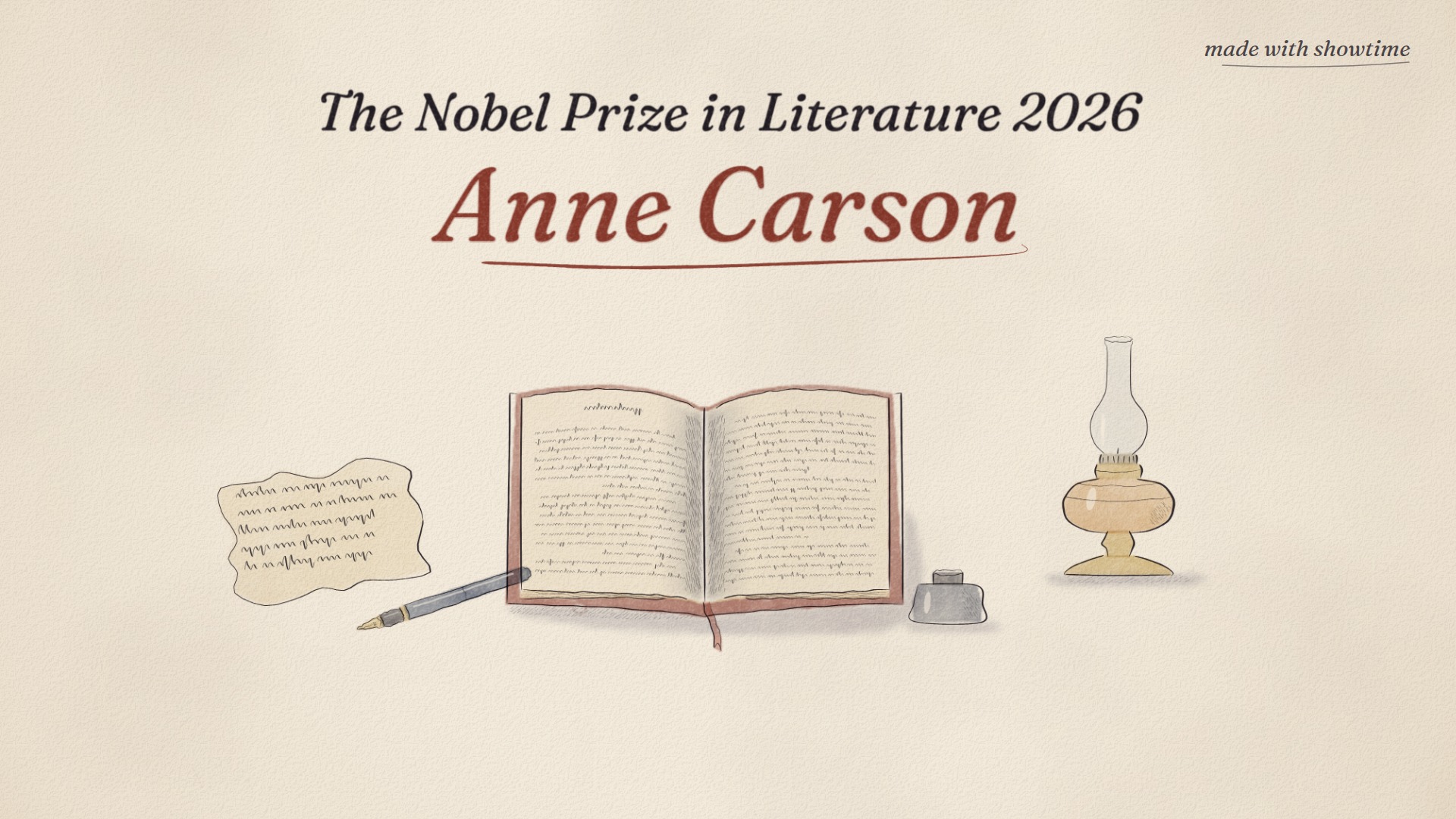
A drawn desk on warm paper: an open book, a fountain pen, a torn scrap of papyrus with lines of scribble and an oil lamp, under the words: The Nobel Prize in Literature 2026, Anne Carson. Play · 2:29

Peace: two rooms

Peace 2026

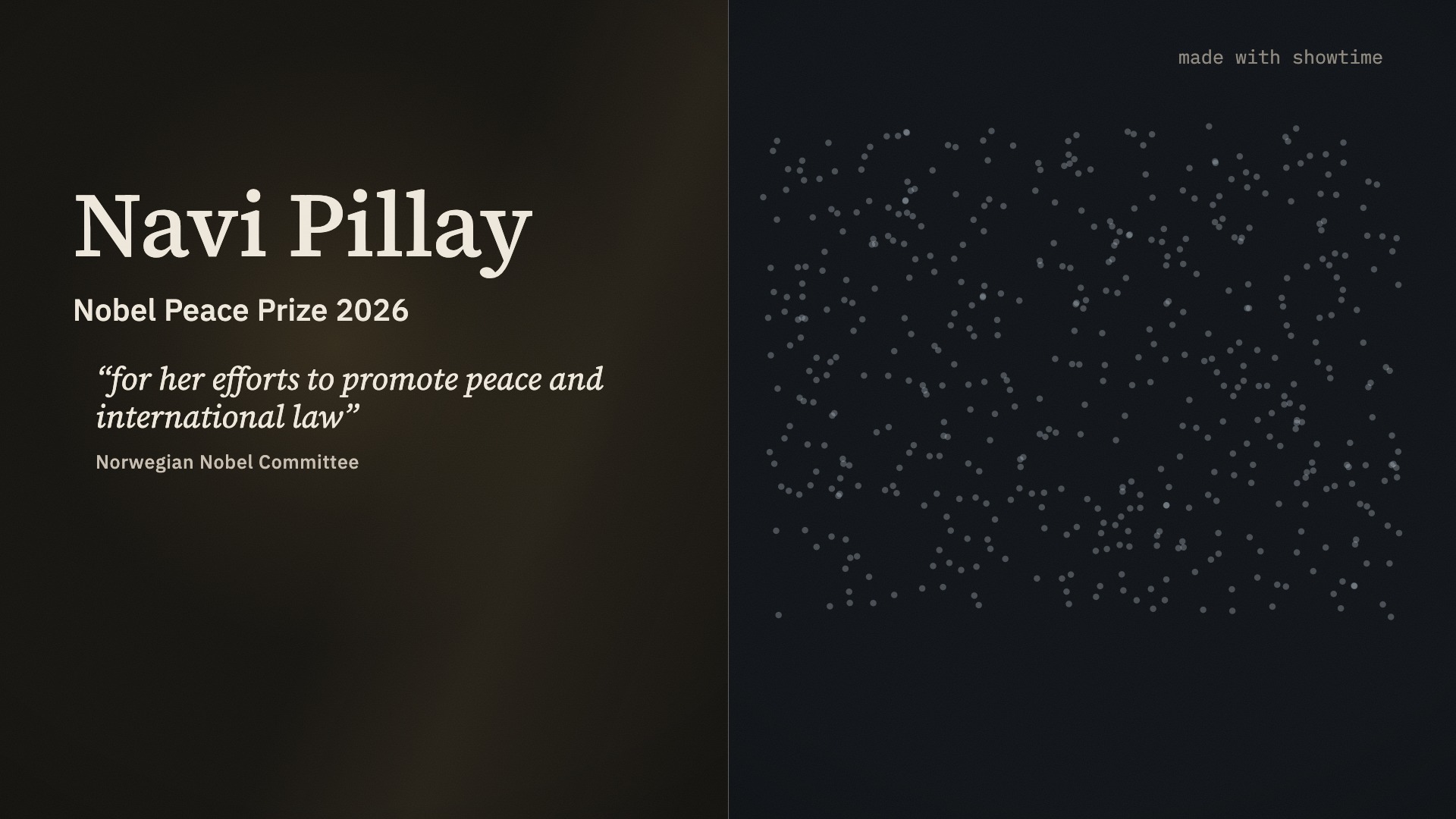
A split screen. On the warm left: Navi Pillay, Nobel Peace Prize 2026, and the citation, for her efforts to promote peace and international law, credited to the Norwegian Nobel Committee. On the cool right: scattered dots, one for each armed-conflict ending in the data. Play · 2:35

Economics: the lab with three equations

Economics 2026

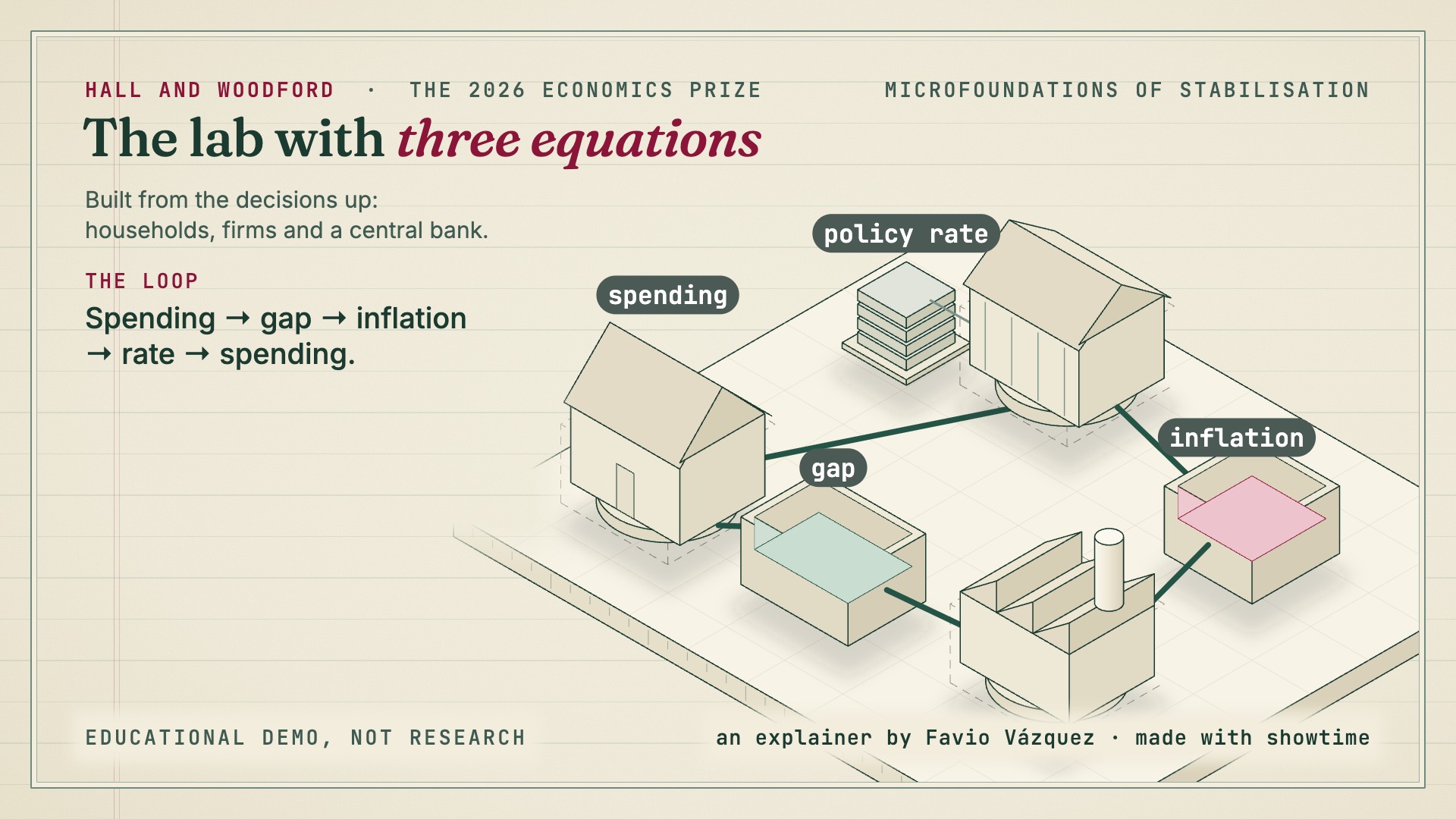
The title The lab with three equations on ledger paper, and a drawing of a house, a factory and a bank joined in a loop: spending, gap, inflation, policy rate. Play · 2:48

The story in one line

If households look ahead, a change in their spending should come only with news, and news cannot be forecast: so Hall asked whether anything forecasts it.

On 12 October 2026 the prize in economic sciences went to Robert E. Hall and Michael Woodford “for microeconomic foundations of macroeconomic stabilisation” (press release).

The prizes

A prize joins the lab once it is announced and its facts are sourced.

Ready

Medicine

Light-gated ion channels and optogenetics: a light-and-heat toy model, a heat budget, a page and a video.

Ready

Physics

Neutrinos from space and IceCube: a toy telescope, why a cubic kilometre, a real 6 PeV event in 3D, a page and a video.

Ready

Chemistry

Mirror-image molecules: Kagan's curve, a molecule that copies its own hand, a race between two mirror forms, a page and a video.

Ready

Literature

Anne Carson and the classical tradition: how much survives, a torn papyrus, one poem through six translators, her books by the forms they name, a page and a video.

Ready

Peace

Navi Pillay and international law: the court record of her cases, how armed conflicts end, whether peace agreements hold, a page and a video.

Ready

Economics

Hall, Woodford and the lab with three equations: a textbook model of rates and inflation, Hall's test on US national accounts, a page and a video.
What is real, and what is a toy

Real

  • The prizes, the people, the dates and the papers. Every sentence is in a claims ledger with its source.
  • Numbers quoted from published papers, each with a link.
  • The published parameters the models start from, and IceCube's public event data (the 6 PeV replay).
  • For Literature, the ancient texts as public-domain editions printed them, byte for byte, each with its page.
  • For Economics, US national accounts from BEA's public bulk files, as BEA published them.
  • For Peace, the court record from the judgments, and the open conflict data of the Uppsala Conflict Data Program as UCDP coded them.

A toy

  • The models: light, heat and nerve cells for Medicine; light in ice, a telescope fit and event rates for Physics; mirror-image molecules that pair up, copy themselves and race for Chemistry. Textbook ideas with simplified settings, every simplification listed.
  • For Literature, our own counts and drawings: letters and words counted in old editions, a hand alignment of six versions of one poem (our rough count, not a quality score), and estimates drawn as dots.
  • For Economics, a textbook model with an illustrative calibration, and our regressions on one data set. Not forecasts, not advice.
  • For Peace, our groupings and clocks on the UCDP data: agreement and ceasefire counted together, "clear outcome", the clock that starts at the first quiet year. Correlation, not cause.
  • Their outputs are for learning. They are not checked against experiments and must not be used to plan an experiment, a device or a treatment.