Neutrinos are tiny particles that pass through almost anything, including the whole Earth. The 2026 Nobel Prize in Physics
went to Francis Halzen for decisive contributions to the IceCube Neutrino Observatory and the discovery of high-energy
neutrinos of astrophysical origin. IceCube watches a cubic kilometre of deep Antarctic ice with 5,160 light sensors.
Why so big, and why so many sensors? Three questions. For each one, make a guess first, then reveal what our small
computer models say. They are toy models: they show the trend, not IceCube's real numbers. Everything was worked out
in advance; nothing is computed live and nothing is sent anywhere.
Step 1 of 4: the odds
If a high-energy neutrino crosses a kilometre of ice, what are the odds it hits anything?
Take one neutrino with an energy of 100 TeV, the kind IceCube hunts. It flies straight through 1 km of ice.
To leave a trace it must hit an atomic nucleus on the way.
Pick one first.
Step 2 of 4: how big a detector?
How many cosmic neutrinos does a block of ice catch in a year?
Neutrinos from space arrive all the time, from every direction, but very few interact. A bigger block of ice holds more
targets. Picture a cube of ice 1 km on each side.
Pick one first.
The Earth as a shield
IceCube also uses the Earth as a filter: neutrinos coming up from below have crossed the planet. At high energy, the Earth
starts to stop them.
Pick one first.
Step 3 of 4: build a telescope
How far apart can the strings of sensors be?
A muon made by a neutrino crosses the ice and gives off a cone of blue light. The sensors record when the light arrives,
and a fit turns those times into a direction on the sky. IceCube's strings of sensors stand about 125 m apart.
Spread them twice as far over the same patch of ice (a quarter as many strings) and fewer sensors see the light.
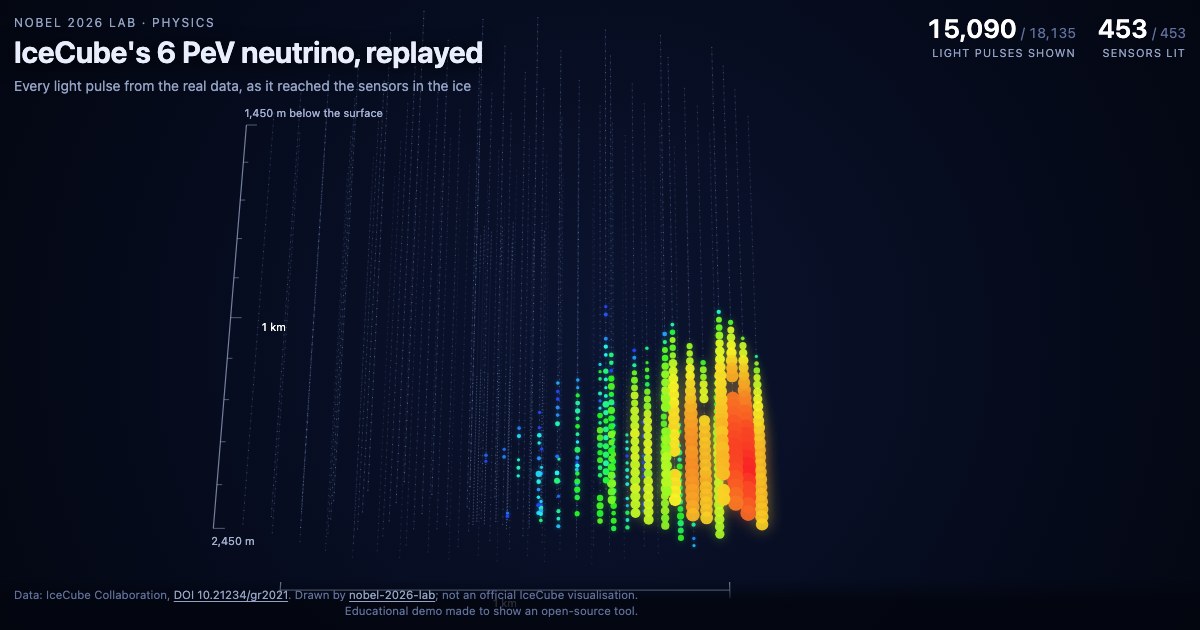 On 8 December 2016 IceCube recorded a particle shower of about 6 PeV, consistent with the Glashow resonance.
Replay all 18,135 light pulses in 3D, from IceCube's public data. Real data, not a toy.