Core Workflow
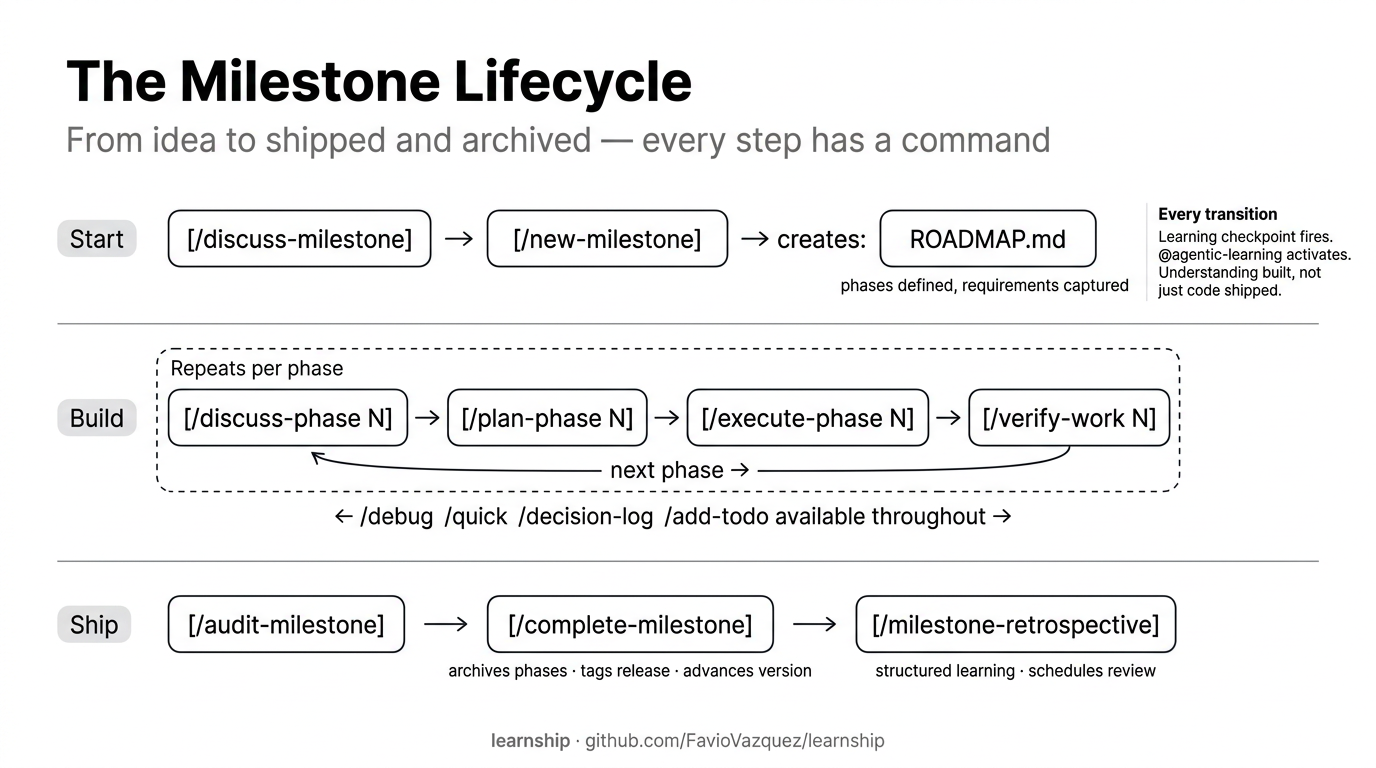
These 8 workflows form the backbone of every learnship project. They take you from zero to shipped.
/new-project
Initializes a new project with full spec-driven scaffolding.
What it does: 1. Structured questioning about what you're building, why, and for whom (standard: 4 exchanges; --deep: extended questioning until full shared understanding) 2. Domain research: stack recommendations, architecture patterns, pitfalls 3. Writes AGENTS.md, .planning/PROJECT.md, .planning/REQUIREMENTS.md 4. Proposes a phase-by-phase ROADMAP.md for your approval
Flags: - --deep — activates extended deep questioning for Step 3: walks every open branch until shared understanding is reached, producing a richer PROJECT.md. (v2.3.4)
When to use: Start of any new project, greenfield or brownfield (after /map-codebase).
Learning checkpoint: @agentic-learning brainstorm [topic]: surface blind spots before planning starts.
/discuss-phase [N]
Captures implementation decisions for phase N before any planning begins.
What it does: 1. Reads your roadmap, prior DECISIONS.md, and domain-aware probes 2. Identifies gray areas and asks targeted questions with scope guardrails (v2.1) 3. Writes CONTEXT.md with domain, decisions, specifics, canonical refs, and deferred ideas 4. Writes DISCUSSION-LOG.md as an audit trail of all options considered (v2.1)
Flags: - --deep — extended deep questioning: walks every decision branch until shared understanding is reached, with a recommended answer per question. Produces a richer CONTEXT.md. (v2.3.4)
Config: Set workflow.discuss_mode: "deep" in config.json to make deep mode the default without passing the flag.
When to use: Before every /plan-phase. Skipping this is the #1 source of misaligned plans.
Learning checkpoint: either-or · brainstorm · explain-first
/plan-phase [N]
Researches the domain and creates executable plans for phase N.
What it does: 1. Reads CONTEXT.md, DECISIONS.md, and AGENTS.md 2. Runs domain research if workflow.research: true 3. Creates 2–4 PLAN.md files as vertical slices — each plan delivers one demoable user-facing behavior end-to-end (data → logic → API → UI → test) (v2.3.4) 4. Runs a verification loop (up to 3 passes) checking for gaps, including horizontal slice detection
Vertical slice planning: Each plan is a tracer bullet — completable and demoable independently. Horizontal plans (all-schema, all-API, all-UI) are flagged by the plan-checker and require revision. Single-layer phases (migration, style pass) set single_layer_justified: true in the plan's frontmatter.
Output: .planning/phases/N-*/N-01-PLAN.md, N-02-PLAN.md, etc.
When to use: After /discuss-phase N is complete.
Learning checkpoint: explain-first · cognitive-load · quiz
/execute-phase [N]
Executes all plans for phase N in wave order with atomic commits.
What it does: 1. Reads all PLAN.md files for the phase 2. Groups plans into waves (independent plans → same wave, dependent → next wave) 3. Executes each task with an atomic git commit 4. Writes SUMMARY.md for each plan
Flags: --wave N to execute only wave N (v2.1). Context window scaling adapts read depth automatically.
When to use: After /plan-phase N is complete.
Parallel option: Set "parallelization": { "enabled": true } to dispatch each plan to its own subagent (Claude Code, OpenCode, Gemini CLI, Codex CLI). Up to 5 concurrent agents per wave.
Learning checkpoint: reflect · quiz · interleave
/verify-work [N]
Manual UAT for phase N with goal-backward verification, agent-assisted diagnosis, and fix planning.
What it does: 1. Shows what was built and the acceptance criteria 2. You test it manually 3. You report any issues in plain language 4. Agent diagnoses root causes and creates targeted fix plans 5. You execute fixes and re-verify
Optional: Live UI smoke test (MCP-enabled platforms)
If @playwright/mcp is configured (works on any MCP-supporting platform: Claude Code, OpenCode, Cursor, Windsurf, Codex CLI, Gemini CLI), learnship can walk the golden path for UI deliverables automatically instead of relying solely on manual testing:
- Navigates to the app's entry point
- Walks through each UI deliverable from the test list
- Takes screenshots at each step
- Checks the browser console for JS errors
Any Playwright failure is treated as a UAT issue (severity: blocker) and added to the Gaps section.
To configure: claude mcp add playwright npx @playwright/mcp (Claude Code), or add @playwright/mcp as an MCP server in your IDE settings.
When to use: After /execute-phase N completes.
Learning checkpoint: - Pass: space · quiz - Bugs found: learn · space
/audit-milestone
Pre-release quality gate: requirement coverage, stub detection, integration check.
What it does: 1. Maps every REQ-ID from REQUIREMENTS.md to implementation 2. Scans for stubs, placeholders, and TODO markers 3. Checks integration between phases 4. Reports coverage gaps as a prioritized list
When to use: Before /complete-milestone. Don't skip this.
/complete-milestone
Archives the milestone, creates a git tag, and advances the project to the next cycle.
What it does: 1. Archives all phase artifacts to .planning/milestones/ 2. Writes a milestone summary 3. Creates a git tag (v[version]) 4. Advances STATE.md and AGENTS.md to the next milestone
When to use: After all phases are verified and /audit-milestone passes.
/new-milestone [name]
Starts a new milestone version cycle.
What it does: 1. Reads the completed milestone's summary 2. Asks questions about the next milestone's goals (or reads MILESTONE-CONTEXT.md if present) 3. Creates a new ROADMAP.md for the next cycle
When to use: After /complete-milestone. Run /discuss-milestone first for better results.
Learning checkpoint: brainstorm [milestone topic]
Common patterns
# Full phase lifecycle (7-step loop)
/discuss-phase N → /plan-phase N → /execute-phase N → /verify-work N → /review → /ship → /compound

# Same loop, one command per line:
/discuss-phase N
/plan-phase N
/execute-phase N
/verify-work N
/review              # two-pass review: spec compliance + quality (v2.4.0)
/ship                # test → lint → commit → push → PR (v2.0)
/compound            # capture what you learned (v2.0)

# With explicit review before executing
/discuss-phase N
/plan-phase N
/list-phase-assumptions N    # preview the plan approach before committing
/execute-phase N

# Brownfield start
/map-codebase
/new-project                  # questions focus on what you're ADDING
# normal phase lifecycle
See Compounding & Quality for the 7 new v2.0 workflows.