Compounding & Quality
These 7 workflows close the loop between building and learning. They turn solved problems into searchable knowledge, enforce multi-persona review, stress-test scope before committing, and ship code through a structured pipeline.
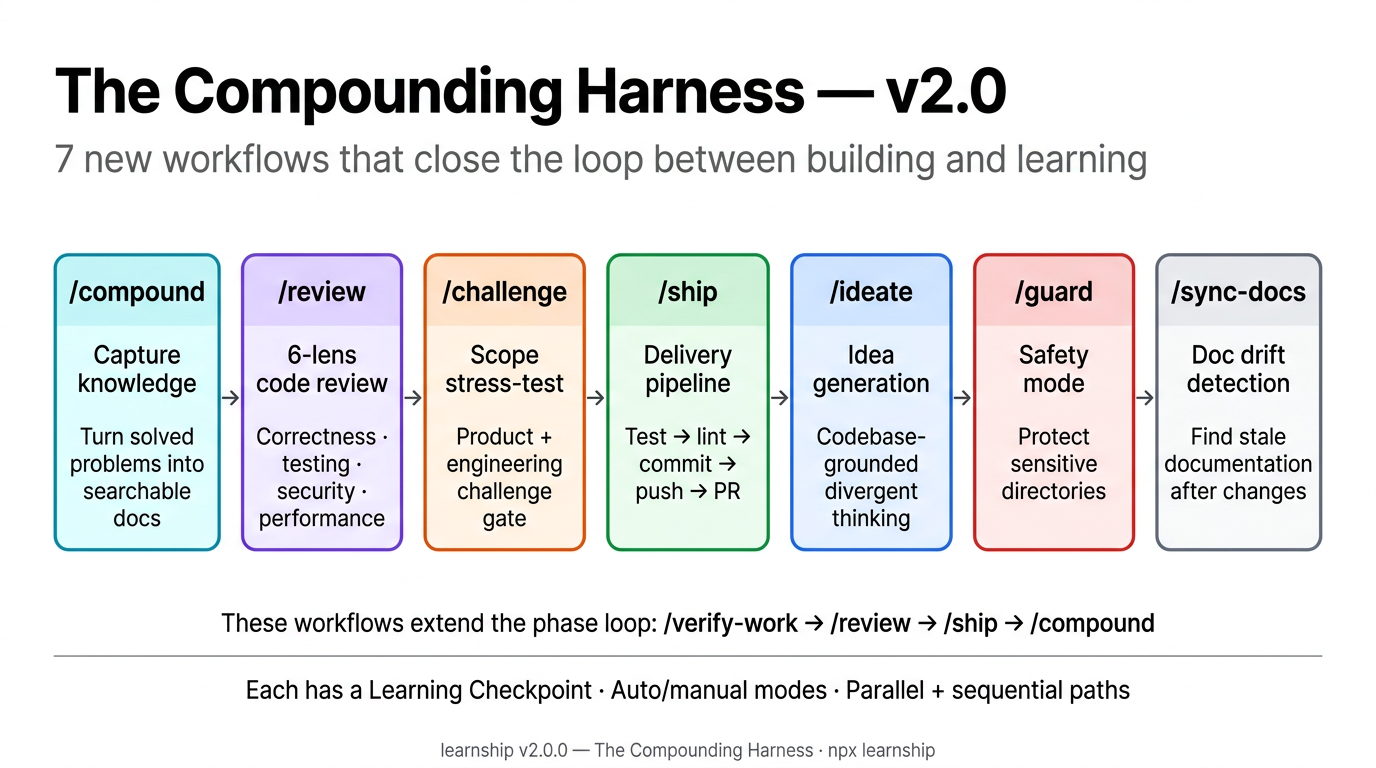
New in v2.0.0.
/compound
Captures a recently solved problem or learned pattern while context is fresh.
/compound                   # full mode: research, overlap detection, dedup
/compound --lightweight     # single-pass, fewer tokens
What it does:
- Asks you to choose Full or Lightweight mode
- Classifies the solution by track (bug or knowledge) and category
- Researches
.planning/solutions/for overlapping prior art - Writes a structured document with YAML frontmatter to
.planning/solutions/[category]/ - Commits and offers
@agentic-learning spaceto schedule review
Output: .planning/solutions/[category]/[filename].md — searchable by /plan-phase (Step 2b) and /knowledge-base.
When to use:
- After
/debugresolves a bug — capture the problem, root cause, and fix - After
/verify-workpasses — capture notable patterns from the phase - After any "aha moment" in a session — compound it before context fades
Agent: solution-writer (inline persona or learnship-solution-writer subagent).
Learning checkpoint: either-or · reflect
/review
Two-pass code review: spec compliance first, then six-lens quality review.
/review                     # interactive mode (default)
/review --report            # report-only, no conversation
/review --autofix           # apply fixes automatically
/review --quality-only      # skip spec compliance pass, run quality review only
Two-pass review:
Pass 1 — Spec Compliance: Reads PLAN.md must_haves (or commit messages as fallback) and classifies each planned deliverable as COVERED, PARTIAL, or MISSING. If gaps exist, asks whether to proceed or stop. This runs first — finding the wrong thing built is more important than finding it well-built.
Pass 2 — Quality: The existing 6-persona review below.
The 6 review lenses:
| Lens | What it checks |
|---|---|
| Correctness | Logic errors, edge cases, off-by-one, null handling |
| Testing | Coverage gaps, missing assertions, test quality |
| Security | Input validation, auth, secrets, injection vectors |
| Performance | N+1 queries, unnecessary re-renders, memory leaks |
| Maintainability | Naming, coupling, dead code, abstraction quality |
| Adversarial | What would a hostile user or a 3am oncall do with this? |
Output: Severity-ranked findings (P0–P3) with confidence scores (0.0–1.0). Only lenses relevant to the diff are activated (e.g., no security lens for a CSS-only change).
Agent: code-reviewer (inline persona or learnship-code-reviewer subagent).
Config: review.auto_after_verify — when true, automatically runs after /verify-work passes.
Learning checkpoint: learn · either-or
/challenge
Product and engineering challenge gate — is this worth building?
What it does:
- Gathers context from PROJECT.md, ROADMAP.md, DECISIONS.md
- Applies two lenses in parallel (or sequentially):
- Product lens: Does this solve a real user problem? Is the scope right?
- Engineering lens: Is this the simplest architecture? What are we coupling to?
- Asks 3–5 forcing questions per lens
- Synthesizes a verdict: proceed, rethink, or reduce scope
- Records the decision to
DECISIONS.md
When to use: Before committing to a milestone, large feature, or major refactor. 15 minutes of challenge prevents weeks of rework.
Agent: challenger (inline persona or learnship-challenger subagent).
Learning checkpoint: either-or · brainstorm
/ship
End-to-end ship pipeline: test → lint → commit → push → PR.
/ship                       # full pipeline
/ship --skip-tests          # skip test step
/ship --dry-run             # show what would happen without executing
What it does:
- Pre-flight: Detects test runner, linter, git status
- Test: Runs detected test suite (skip with
--skip-testsorship.auto_test: false) - Lint: Runs detected linter if present
- Stage:
git addchanged files - Commit: Conventional commit format (
feat:,fix:,chore:, etc.) whenship.conventional_commits: true - Push:
git pushto current branch - PR: Creates pull request with auto-generated description when
ship.pr_template: true - Confirm: Shows summary and suggests
/compoundfor notable patterns
Optional: Live smoke test (before PR): When @playwright/mcp is configured on any MCP-enabled platform, /ship runs a quick smoke test on the changed flows before creating the PR. Catches rendering failures that tests don't. If the smoke test fails, the ship pipeline stops.
Config options:
| Key | Default | What it controls |
|---|---|---|
ship.auto_test | true | Run tests before shipping |
ship.conventional_commits | true | Use conventional commit format |
ship.pr_template | true | Auto-generate PR description |
Learning checkpoint: reflect
/ideate
Codebase-grounded divergent ideation — discover what's worth building next.
What it does:
- Scans codebase for TODOs, test gaps, hotspots, and friction points
- Generates 15–25 ideas across four thinking frames:
- User pain: What frustrates users right now?
- Inversion: What if we did the opposite of the current approach?
- Assumption-breaking: What are we assuming that might be wrong?
- Leverage: Where would a small change have outsized impact?
- Deduplicates and adversarial-filters weak ideas
- Presents top 5–7 ranked survivors with effort estimates
When to use: Between milestones (after /complete-milestone, before /discuss-milestone), or when you feel stuck on what to build next. Requires an existing project — for pre-project ideation, use @agentic-learning brainstorm [idea] instead.
Agent: ideation-agent (inline persona or learnship-ideation-agent subagent).
Learning checkpoint: brainstorm · either-or
/guard
Safety mode for sensitive phases — warns before destructive commands and locks file scope.
What it does:
- Determines scope from arguments or asks interactively
- Creates
.planning/guard-state.mdwith protected paths and rules - While active:
- Warns before any destructive command (
rm,DROP,truncate, etc.) - Warns before editing files outside the guarded scope
- Adds a
🛡️ GUARDprefix to the session banner - Persists across sessions via
guard-state.md - Deactivate with
/guard --off
When to use: Working on auth, payments, database migrations, or any area where accidental changes could be catastrophic.
Learning checkpoint: learn
/sync-docs
Detects stale documentation after code changes.
What it does:
- Identifies documentation files (README, docs/, API docs, inline JSDoc/docstrings)
- Compares against recent git changes
- Scans for: renamed references, outdated paths, stale examples, broken links
- Reports findings by severity (high/medium/low)
- Auto-fixes simple cases with
--autofix(renamed references, updated paths)
When to use: Before /complete-milestone (it's suggested automatically), after large refactors, or periodically during long milestones.
Learning checkpoint: learn
The extended phase loop
v2.0 extends the phase loop with three new steps after verification:
flowchart LR
    DP["/discuss-phase"] --> PP["/plan-phase"] --> EP["/execute-phase"] --> VW["/verify-work"]
    VW --> RV["/review"]
    RV --> SH["/ship"]
    SH --> CP["/compound"]
    CP -->|"next phase"| DP
    VW -->|"all done"| AM["/audit-milestone"]
# Full v2.0 phase lifecycle
/discuss-phase N
/plan-phase N
/execute-phase N
/verify-work N
/review # multi-persona code review
/ship # test → lint → commit → push → PR
/compound # capture what you learned
/discuss-phase N+1 # next phase
The last three steps are recommended after every phase. They surface naturally through done-banner suggestions after /verify-work passes.
v2.1 extends this with optional per-phase workflows:
/verify-work N       # manual UAT
/secure-phase N      # v2.1: STRIDE security verification
/review              # multi-persona code review
/ship                # test → commit → push → PR
/compound            # capture what you learned
/extract-learnings N # v2.1: structured meta-knowledge extraction
See also: Security & Documentation · Session & Learnings · Recovery
/ideate (v2.1 enhanced)
v2.1 adds --explore mode for Socratic exploration alongside the existing scan mode:
/ideate                          # scan mode: codebase hotspots → ranked ideas
/ideate [focus]                  # focused scan on a specific area
/ideate --explore [topic]        # v2.1: Socratic exploration with mid-conversation research
In --explore mode, the agent asks one question at a time, offers mid-conversation research when factual questions arise, and crystallizes outputs to notes, todos, decisions, or phase proposals.
Agent personas
17 agent personas, each available as inline (sequential with <persona_context> blocks), @./agents/ file reference, and dispatch (parallel subagent via Task()). On Windsurf, personas are installed as model_decision rules for native conditional adoption.
| Agent | Role | Sandbox mode (Codex) |
|---|---|---|
planner | Creates executable implementation plans | workspace-write |
executor | Implements code from plans, one task at a time | workspace-write |
verifier | Checks plans/implementation against requirements | workspace-write |
debugger | Diagnoses root cause, not symptoms | workspace-write |
researcher | Domain investigation, web research, pattern discovery | workspace-write |
project-researcher | Domain ecosystem research for /new-project (v2.3) | workspace-write |
research-synthesizer | Synthesizes 4 research files into SUMMARY.md (v2.3) | workspace-write |
phase-researcher | Focused phase research for /plan-phase (v2.3) | workspace-write |
roadmapper | Creates phased roadmaps from requirements (v2.3) | workspace-write |
solution-writer | Writes structured solution documents | workspace-write |
code-reviewer | Reviews code through persona-specific lenses | read-only |
challenger | Stress-tests proposals through forcing questions | read-only |
ideation-agent | Generates codebase-grounded improvement ideas | read-only |
plan-checker | Validates plan quality, missing steps, estimates | read-only |
security-auditor | STRIDE threat verification (v2.1) | read-only |
doc-writer | Documentation generation and verification (v2.1) | workspace-write |
doc-verifier | Verifies docs match live codebase (v2.3) | read-only |